

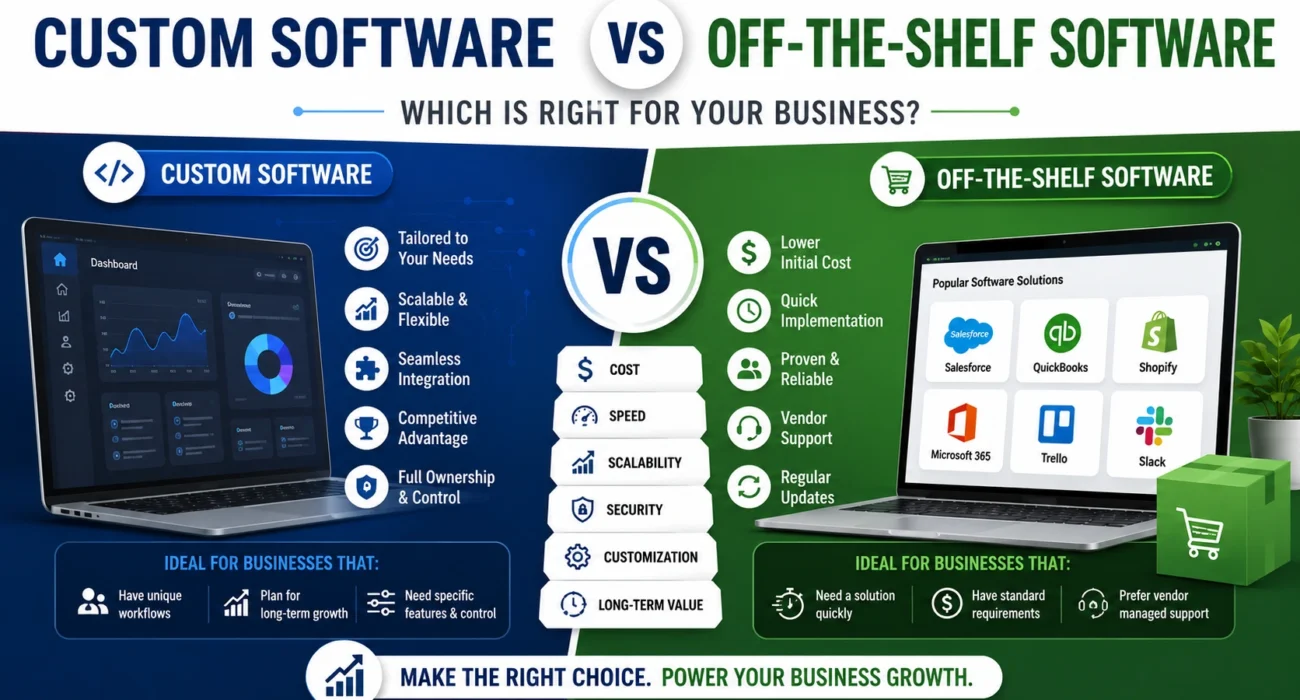
Choosing the right software can significantly impact your business’s efficiency, growth, and profitability. As companies increasingly rely on technology to streamline operations and improve customer experiences, one question often arises: Should you invest in custom software or choose an off-the-shelf solution?
Both options offer unique benefits and challenges. Understanding the differences between custom software and off-the-shelf software can help you make an informed decision that aligns with your business goals.
In this guide, we’ll compare both approaches, covering costs, scalability, security, and long-term value to help determine which solution is best for your business.
What Is Off-the-Shelf Software?
Off-the-shelf software refers to pre-built applications designed for a broad audience and sold to multiple businesses. These solutions are ready to use and often come with standard features that address common business needs.
Popular examples include:
- Microsoft 365
- QuickBooks
- Salesforce
- Shopify
- Trello
These platforms are designed to serve a wide range of industries and business types without requiring extensive customization.
Advantages of Off-the-Shelf Software
1. Lower Initial Cost
One of the biggest advantages of off-the-shelf software is affordability. Businesses typically pay a subscription fee or one-time license cost rather than funding an entire development project.
2. Faster Implementation
Since the software is already built, deployment can happen almost immediately. Businesses can start using the platform within hours or days instead of waiting months for development.
3. Proven Reliability
Established software solutions have been tested by thousands or even millions of users. Bugs are usually identified and fixed quickly through regular updates.
4. Vendor Support
Most commercial software providers offer documentation, customer support, and ongoing maintenance, reducing the burden on internal teams.
Limitations of Off-the-Shelf Software
- Limited customization options
- Unnecessary features that clutter workflows
- Ongoing subscription costs
- Dependence on third-party vendors
- Potential integration challenges
What Is Custom Software?
Custom software is specifically designed and developed to meet the unique needs of a business. Unlike generic software, custom solutions are built around your workflows, objectives, and operational requirements.
Examples include:
- Custom ERP systems
- Business management platforms
- Customer portals
- Inventory management solutions
- Industry-specific applications
Advantages of Custom Software
1. Tailored to Your Business
Custom software is built around your exact requirements. Every feature serves a purpose, resulting in improved efficiency and productivity.
2. Greater Flexibility
As your business evolves, custom software can be modified and expanded without waiting for a vendor to release new features.
3. Competitive Advantage
Unique software capabilities can help differentiate your business from competitors using standard tools.
4. Better Integration
Custom solutions can seamlessly connect with your existing systems, databases, and third-party applications.
5. Full Ownership
You maintain control over the software, data, features, and future development roadmap.
Potential Drawbacks of Custom Software
- Higher upfront investment
- Longer development timelines
- Requires ongoing maintenance
- Greater responsibility for updates and support